In my opinion, the best way to understand fibromyalgia is to think of it as a broken stress response system that is stuck in the "on" position. Or said another way, our sympathetic nervous system (SNS) is chronically activated. Living in a constant state of "fight or flight" wreaks havoc on the body: preventing deep sleep; keeping muscles tense, leading to pain and tenderness; impairing digestion and energy production; and throwing hormones out of balance. This ultimately causes pain-sensing nerves to increase their volume at the same time it lessens the brain's ability to block those signals. The end result is faulty pain volume control, also called central sensitization or nociplastic pain.
Because the ability to sense and respond to danger is essential for survival, the stress response involves almost every body system. The brain and sympathetic nerves communicate with the immune system and with the network of pain-sensing nerves throughout the body. A functioning stress response is designed to provide a temporary burst of activity to give us enough energy and time to either fight an attacker or run away. However a chronically activated stress response results in fatigue and muscle pain. Brief fight-or-flight activation results in hypervigilance, making us more aware of our surroundings, and readies our muscles for action. Long-term activation causes poor sleep as the brain remains perpetually alert, and results in muscle tension and pain.
In particular, I think the myofascial web, the sympathetic nervous system (SNS) and the immune system together play the biggest roles in fibromyalgia. It's like a chain reaction that starts with a brain stuck in sympathetic mode, impairing sleep, tightening muscles, activating immune system and ultimately pushing the CNS into inflammation and hypersensitivity. I am not the only one with this idea. Dr. Manuel Martinez-Lavin has been studying the role of the SNS in fibromyalgia for over 25 years, and he describes the root of fibromyalgia symptom as "relentless sympathetic activity".
This chain reaction concept is my hypothesis, my way of connecting the dots so to speak. But each of these dots has plenty of supporting scientific evidence, that I share with you in pretty much every post on this site! I think most of the information we need to solve fibromyalgia is out there, but it needs to be gathered and organized in the right way. It is my intention and hope with this site that I can help fast-forward fibromyalgia science by creating a trail of breadcrumbs.
 Ginevra Liptan, MD
I hope to at least generate better questions for scientists to work on, because we definitely don't need any more studies about exercise and fibromyalgia. (Don't get me wrong, I appreciate any research interest in fibromyalgia but I think this question is answered by now. Yes, exercise helps, got it!)
The fibromyalgia chain reaction
A medical journal published my fibromyalgia chain reaction hypothesis in 2023, you can read the full article here.
 Ginevra Liptan
Here is an excerpt/summary of the article translated into plain language.
Fibromyalgia is not typically considered an autoimmune disease, however some recent mouse studies suggest otherwise. When antibodies from fibromyalgia subjects were infused into health mice, they developed clinical signs of fibromyalgia such as pain and fatigue.
This paper argues that the known pathology and clinical features of fibromyalgia pain can be considered a chain reaction beginning with persistent sympathetic nervous system (SNS) hyperactivity and ending with central sensitization. In this hypothesis, excessive SNS signaling creates pathologically tense muscles and pushes the immune system to start mistakenly attacking itself in an autoimmune reaction.
It is normal for the immune system to briefly activate against our own tissue as part of the body's natural healing response to injury. This becomes problematic only when it is constant. Antibodies are involved in normal tissue healing, but an impaired immune response can generate pathological levels of autoantibodies to our own tissue.
In fibromyalgia these autoantibodies are attempting to repair the damage from chronic microtraumas that are generated by pathologically tense muscles and fascia. Abnormal levels of autoantibodies activate a variety of immune cells AND nerve cells with the end result of central sensitization.
Other studies published after my editorial found even more elements of the immune system that may be involved in generating pain hypersensitivity of fibromyalgia. Expanding beyond just role of antibodies but including other key players in the immune system including neutrophils and mast cells.
About a year after my article was published, one of the most amazing moments of my career occurred. One of the lead authors of the mouse antibody study sent me an email that she found my article "inspiring" (OMG OMG!). If I could do it all over I would probably get a PhD and devote half my career to research. Alas at my advanced age it is nearly impossible to transition into research, and funding for research has essentially evaporated in the past few years. (I still hold out hope that maybe Lady Gaga or another wealthy benefactor wants to donate 10 million dollars to help me start a research institute dedicated to solving fibromyalgia. So if anyone knows her, please put in a good word!)
This video explainer also describes in plain language my chain reaction hypothesis.
Targeting the chain reaction for fibromyalgia treatment
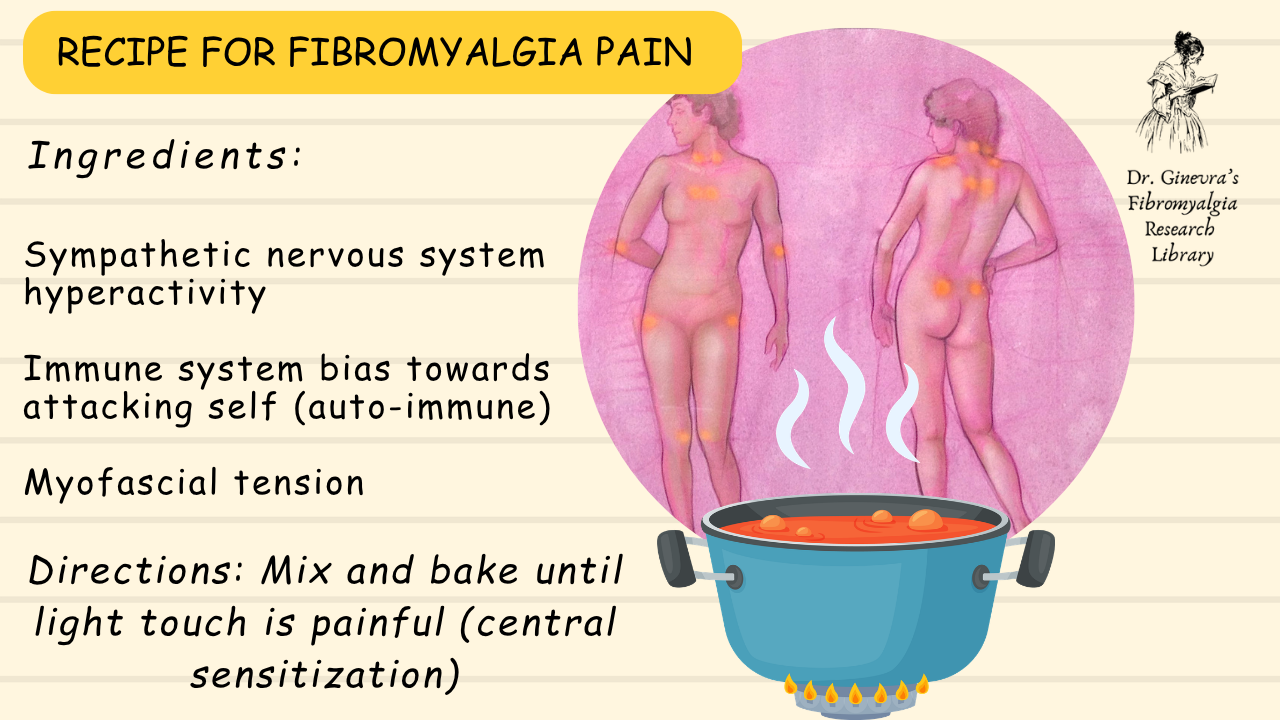
The broken pain response system in fibromyalgia is the end-result of a cascade of events starting with SNS hyperactivity, leading to chronic myofascial tension and a state of autoimmunity. Mixing these three ingredients together and generates a CNS that is hypersensitive to pain signals and possibly even generating some "phantom" pain signals of its own accord.
Right now we don't have a way to permanently turn down the stress response. So effective fibromyalgia treatment involves fighting each step in the chain reaction, including activating the relaxation response, improving sleep quality and reducing myofascial tension. Find more specific treatment guidance, for you and your doctor, in my book The FibroManual.