
No matter how you measure sympathetic nervous system (SNS) activity in fibromyalgia it is abnormal, including how much electricity is passing through sympathetic nerves headed to the muscle. This is called muscle sympathetic nerve activity (MSNA) and it gives us a direct signal of sympathetic activity.
Even at rest a muscle receives a tiny amount of electrical signal via sympathetic nerves, like a pilot light. But when activated as part of the stress response, the electrical signal gets 'ignited' and sends stronger messages down the sympathetic nerves to the body. When the brain senses danger, much faster and stronger signals are sent down to the muscle, impacting both blood flow and muscle tension. The SNS exerts multiple effects at the muscle level that support intense motor activity that are appropriate for a fight-or-flight response.
The sympathetic nervous system (SNS) modulates several functions in skeletal muscle fibers, including metabolism, ionic transport across the membrane, and contractility. These actions, together with the sympathetic control of other organ systems, support intense motor activity. However, some SNS actions on skeletal muscles may not always be functionally advantageous. Roatta & Farina 2010
In the lab we can measure muscle sympathetic nerve activity by placing a tiny electrode in a nerve in the leg. The device recognizes and records electrical pulses of the type sent out by SNS. Then those signals are isolated and magnified, as shown below.
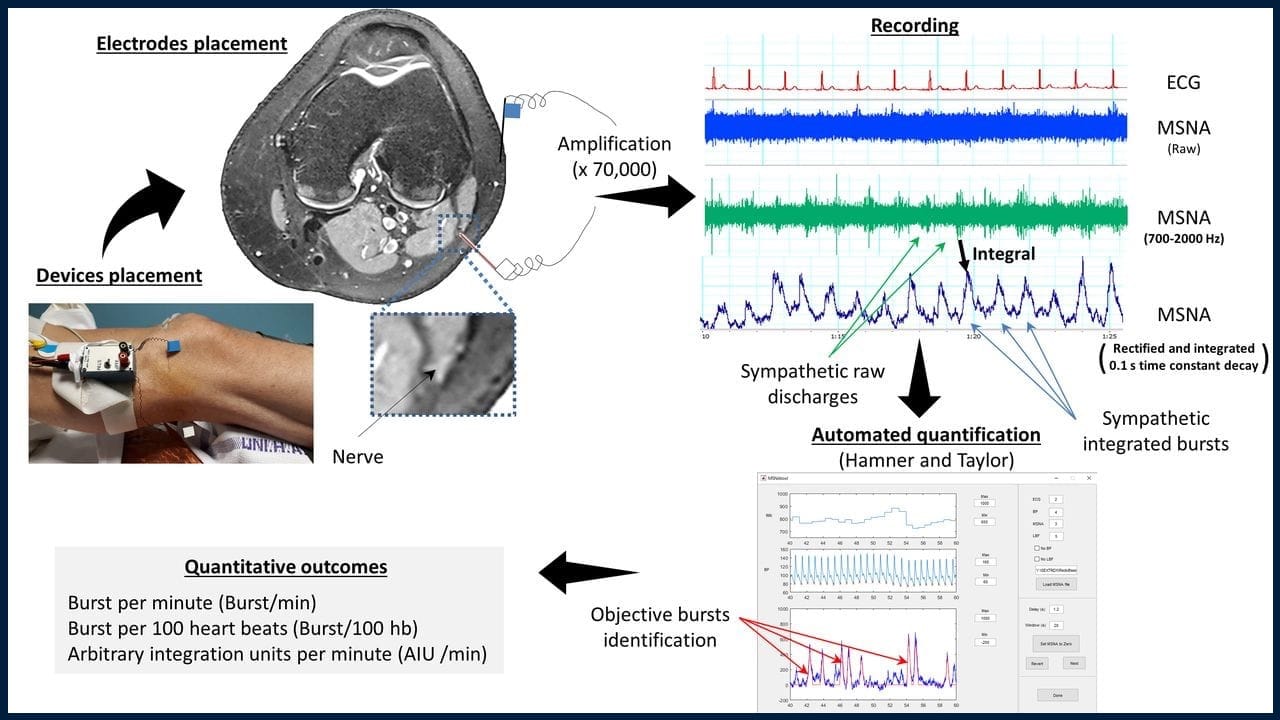
The frequency of electrical bursts shooting down the nerves to the body reflects the level of SNS activation in the brain. More bursts per minute equals more SNS activity. Frequent MSNA pulses tell the muscles to adjust blood flow and muscle tension to optimize muscles for fighting or fleeing. This is a healthy and life-saving response that is great in the short-term, especially if there is actually some danger you need to escape. But if the SNS signals to muscles are stuck on high volume all the time as we see in fibromyalgia, it results in pathologically tense muscles that are tender and fatigue easily.
MSNA results in fibromyalgia
The original study using this technique in fibromyalgia way back in 1992 found normal MSNA levels. However as computers got better at processing and isolating the sympathetic signals from background electrical noise, a clear picture arose of elevated MSNA levels in fibromyalgia. Results also showed higher MSNA signals correlated with higher pain levels. Let's dive a little deeper into a few of these studies.
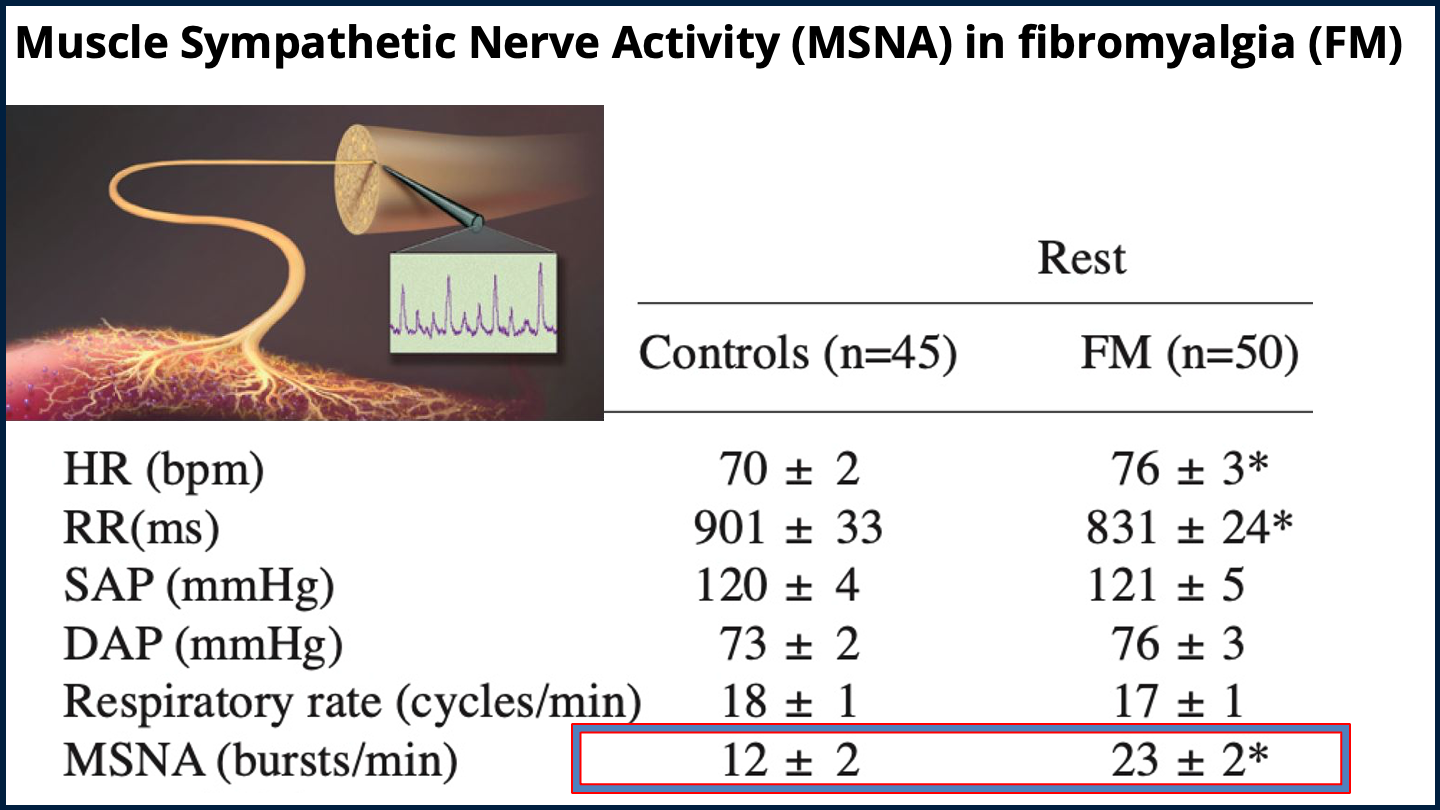
In a study published in 2017, fibromyalgia patients demonstrated elevated MSNA levels under resting conditions compared to healthy control. At rest, the electrical activity racing down the sympathetic nerves out to fibromyalgia muscles was almost twice that of healthy controls, as you can see in the highlighted portion of this chart. This means that the fibromyalgia muscles were getting twice the "fight and flight" messaging as healthy muscles, which is going to lead to tight, overactive and painful muscles that fatigue easily.
Stress and pain
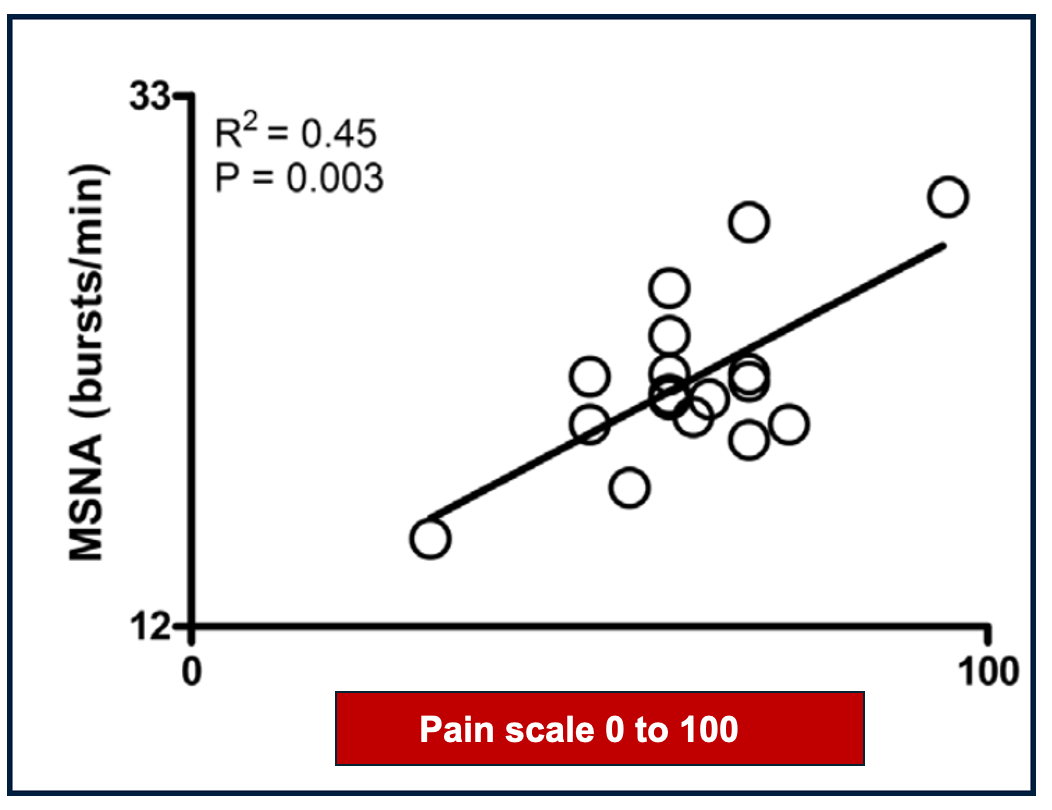
Another also found elevated MSNA signals in fibromyalgia muscles, and took it a step further by comparing pain levels to those values. MSNA levels linearly correlated with pain intensity, as shown in the graph below. This means those subjects with higher MSNA scores were also the ones who described higher pain levels. And a third study found similar results: higher MSNA levels in fibromyalgia that correlated with pain levels.
More stress equals more pain.
Connecting the dots
How does elevated MSNA tie into the big picture of fibromyalgia? Higher MSNA not only tells us that the sympathetic nervous system is on "red alert", but also that the muscles in particular are feeling the brunt of this effect. Higher MSNA means more muscle tension and fatigue and is a key link in the fibromyalgia chain reaction that generates muscle pain.
References and their significant conclusions
 Christoph Best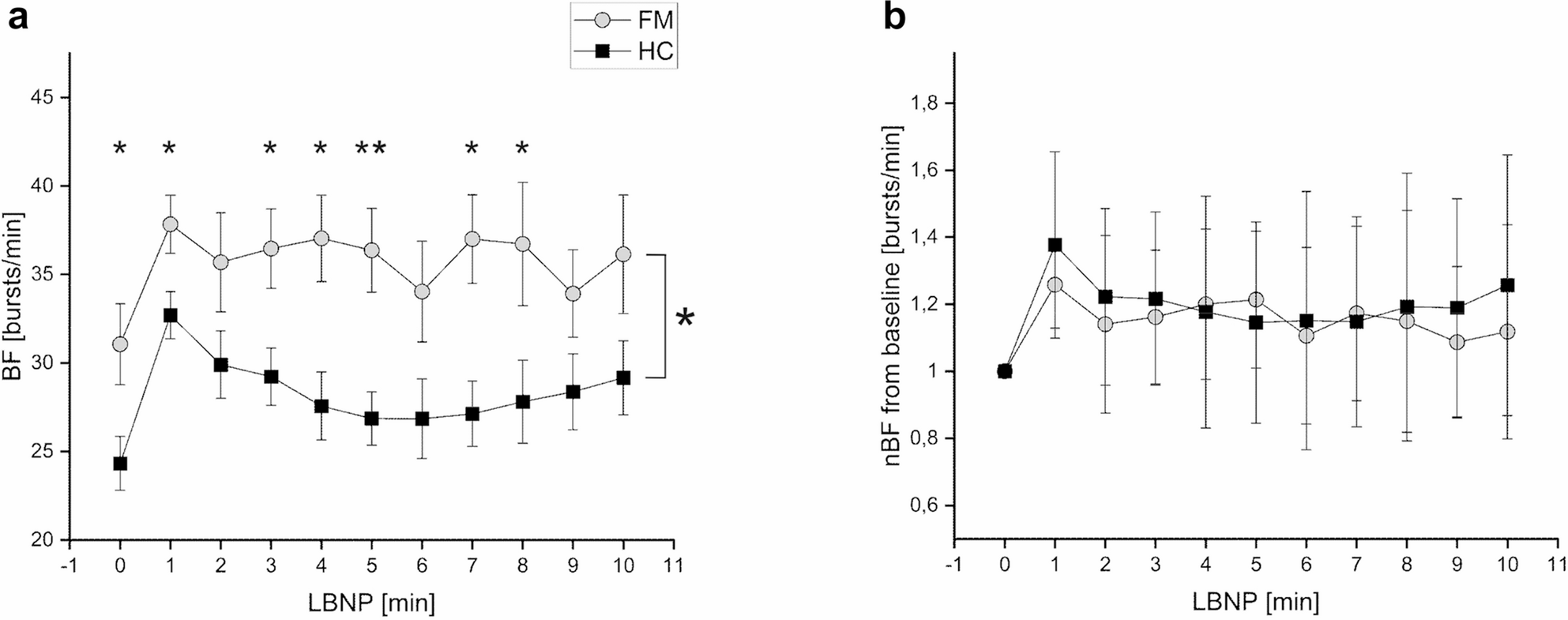
FM subjects showed increased sympathetic outflow at rest. Pain intensity was positively correlated with resting sympathetic outflow. Higher pain levels were seen in those with higher MSNA values.
 M. Rizzi
Our data confirm that, at rest, FM patients have a greater MSNA... and suggests an overall increase in resting sympathetic activity.
 A.R. Zamunér
There was a linear correlation between the sympathetic efferent discharge activity (MSNA burst rate) and the pain intensity.
MSNA was obtained from 12 patients with FM and 11 health controls at rest, and MSNA was higher in FM subjects.