
We can measure the level of sympathetic nervous system (SNS) activation by the body's response to changes in position like standing up. It's a bit of a Goldilocks situation. Just the right amount of SNS signals, occurring at just the right time, are critical for regulating necessary adjustments in vascular tone, heart rate, and blood pressure upon standing. This is a process which often malfunctions in fibromyalgia, because our SNS system is hyperactive. In one study over 60% of patients reported having symptoms upon standing, also called orthostatic intolerance. Symptoms can include lightheadedness, tunnel vision, sweating, becoming pale, yawning, and nausea or even fainting.
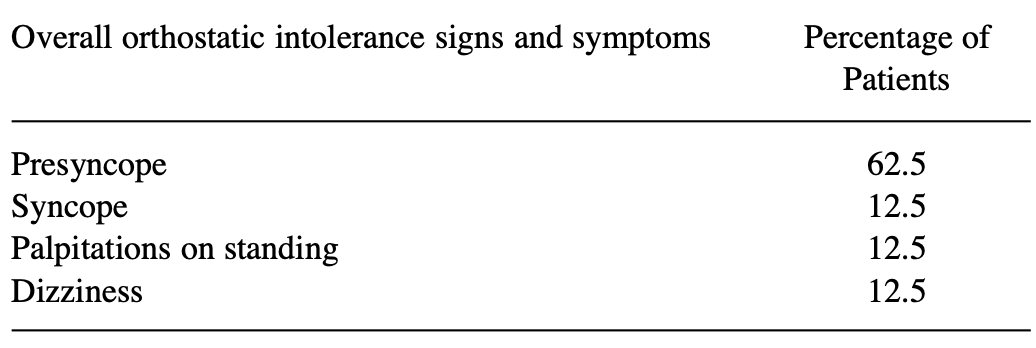
When the body moves from a lying or seated position to standing, the effect of gravity causes pooling of blood in the legs, which means the brain is not getting as much blood flow. The brain REALLY likes its blood flow. A brain starved of blood flow sends out messages of dizziness, nausea, or even fainting. So why do most people stand up with no problem? When a healthy person stands up the brain briefly activates the sympathetic nervous system. This increases how fast and heard the heart is pounding, and tightens blood vessels in the lower legs. Together these changes act to prevent a significant drop in blood pressure (hypotension) and maintain adequate blood flow to the brain. If the SNS is not able to generate these changes, or if the changes made are not strong or fast enough, the brain experiences low blood pressure manifested by dizziness or fainting. Another sign of SNS malfunction is by abnormally prolonged, excessively fast heart rate upon standing. Both of these abnormal responses upon standing are often reported in people with fibromyalgia.
Two ways the SNS can malfunction in response to standing
-
Orthostatic hypotension (meaning low blood pressure upon standing). It is a sudden drop in blood pressure when you stand up from sitting or lying down, causing dizziness, lightheadedness, or fainting because the body fails to compensate for gravity's effect on blood flow. It's diagnosed by a significant drop in systolic (≥20 mmHg) or diastolic (≥10 mmHg) blood pressure within three minutes of standing. Systolic blood pressure is the 'top number' and diastolic is the 'bottom number' of a blood pressure reading like 140/90.
-
POTS (postural orthostatic tachycardia syndrome) This describes a prolonged abnormally fast heat rate upon standing. Blood pressure is typically maintained but the heart rate rises with standing by more than 30 beats per minute (bpm). A heart beating that fast is actually not very effective at moving blood flow, so also can see dizziness, lightheadedness, and other symptoms that look very similar to orthostatic hypotension.The most prominent feature of POTS is the profound tachycardia (fast heart rate) that develops upon standing. Thus, blood pressure and heart rate need to be measured before and up to 10 minutes after standing, as some patients may develop delayed tachycardia. Because healthy individuals often develop transient tachycardia immediately after standing, only a sustained heart rate increase of more than 30 bpm is considered diagnostic of POTS. It is estimated that at least 20% of people with POTS also have fibromyalgia. Although I could not find any research data about how often people with fibromyalgia have POTS, in my clinical experience it seems to be around 30-40%.
Tilt table testing
One method to test the sympathetic nervous system response to standing is by simply measuring blood pressure, heart rate and symptoms while lying down, and then again while standing. This definitely gives us some useful information but the picture is clouded by the fact that the very act of standing up tightens muscles in the legs, which acts to boost blood pressure. To isolate down to just what the SNS is doing in response to change, not what the SNS plus leg muscles are doing, we have to look at passive standing. This can be achieved with a tilt-table test, also called a head-up tilt (HUT) test.The subject is strapped to a table that is initially flat, and then the head of the bed is slowly elevated usually to a 70° head-up angle. And at the same time devices are monitoring vital signs and the electrical activity of sympathetic nerves sending "constrict" signals to blood vessels in legs. Other testing protocols involve spending variable amounts of time in different head up tilt angles. And yes, this testing is as unpleasant as it sounds. Early in my career I learned to be really selective in when to order a tilt-table test.
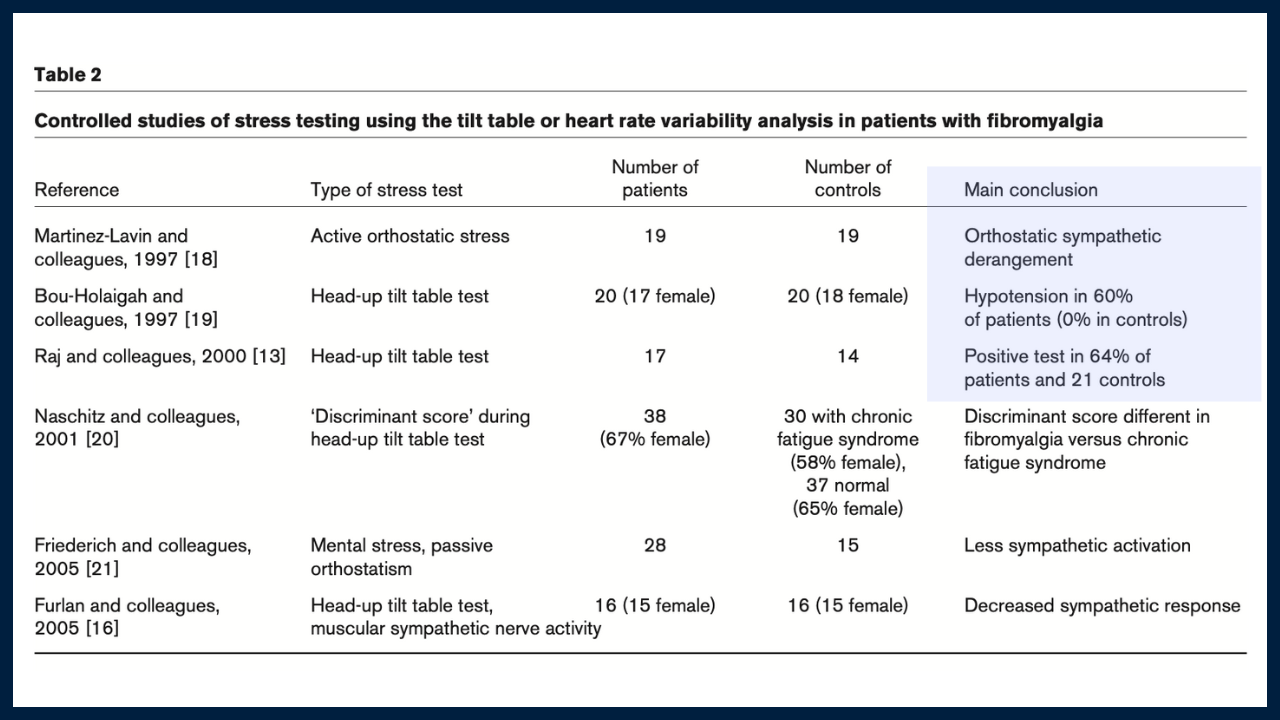
During a head-up tilt (HUT) test, gravity causes blood to pool in the lower body. The body's normal healthy response to this involves increasing heart rate and generating stronger heart contractions, as well as by constricting blood vessels The normal responses seen in a tilt table test is a small increase in the heart rate and a minor reduction, or stable, blood pressure. Multiple studies have found that people with fibromyalgia have abnormal responses during tilt-table testing. About 60% of FM patients show abnormally fast heart rate or a drop in blood pressure during head-up tilt table testing.
One study found that almost half of fibromyalgia subjects actually fainted during the testing.
A table summarizing research findings is below. You can find links to articles and key conclusions at the end of this article.
Measuring blood vessel constriction during tilt table testing
To adjust to changes in position the body's normal response is to tighten blood vessels in the legs, which is triggered by electric impulses transmitted through the sympathetic nerves to the blood vessels. This is called muscle sympathetic nerve activity (MSNA) and can be measured by inserting a needle electrode into a nerve. In a healthy person, at rest should see low MSNA and then high MSNA activity as the table inclines, pushing the blood vessels in muscles of leg to constrict to help maintain stable blood pressure and heart rate. This is a healthy, adaptive response to orthostatic stress.
 Ginevra Liptan, MD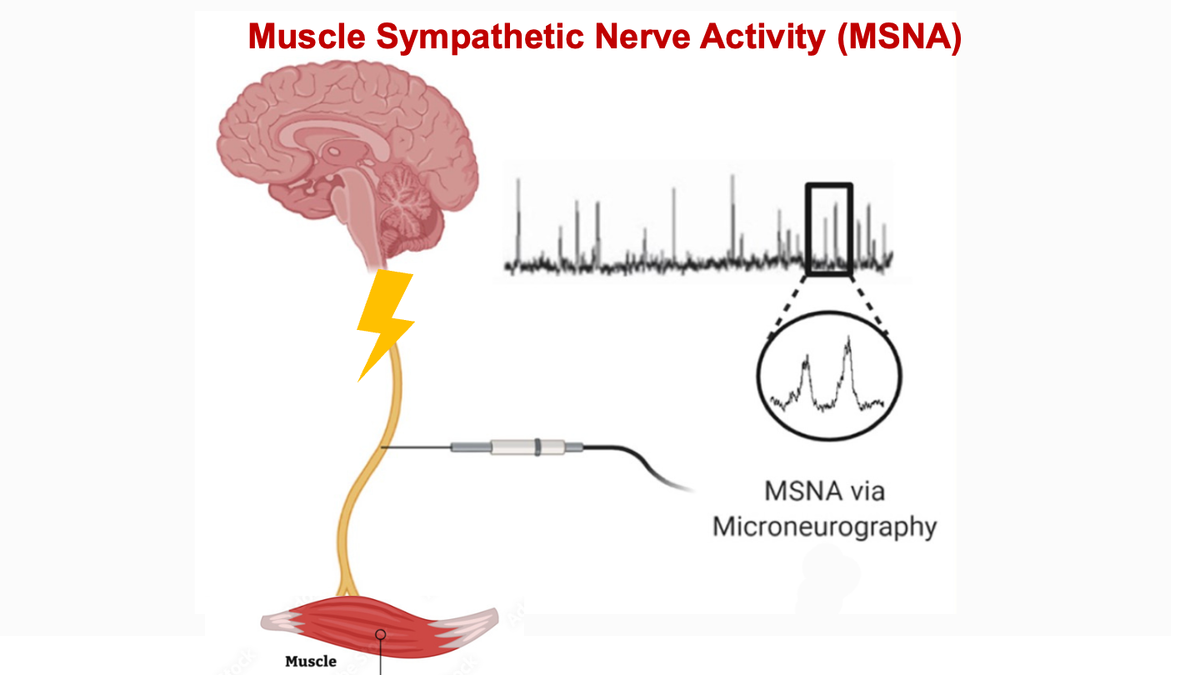
In FM what we see is high MSNA at rest, with only small increase on tilting because can't go above the "ceiling" level of MSNA that the body can generate. One study found that for controls, their baseline MSNA was 12, and more than doubled in response to tilting. However fibromyalgia subjects at rest had MSNA that was already quite high at 23, and was only able to bump up a few points during tilting. The MSNA elevation at rest is a key marker on its own for SNS hyperactivity in FM and the fact it can't go up much more is the one reason we see symptoms upon standing.
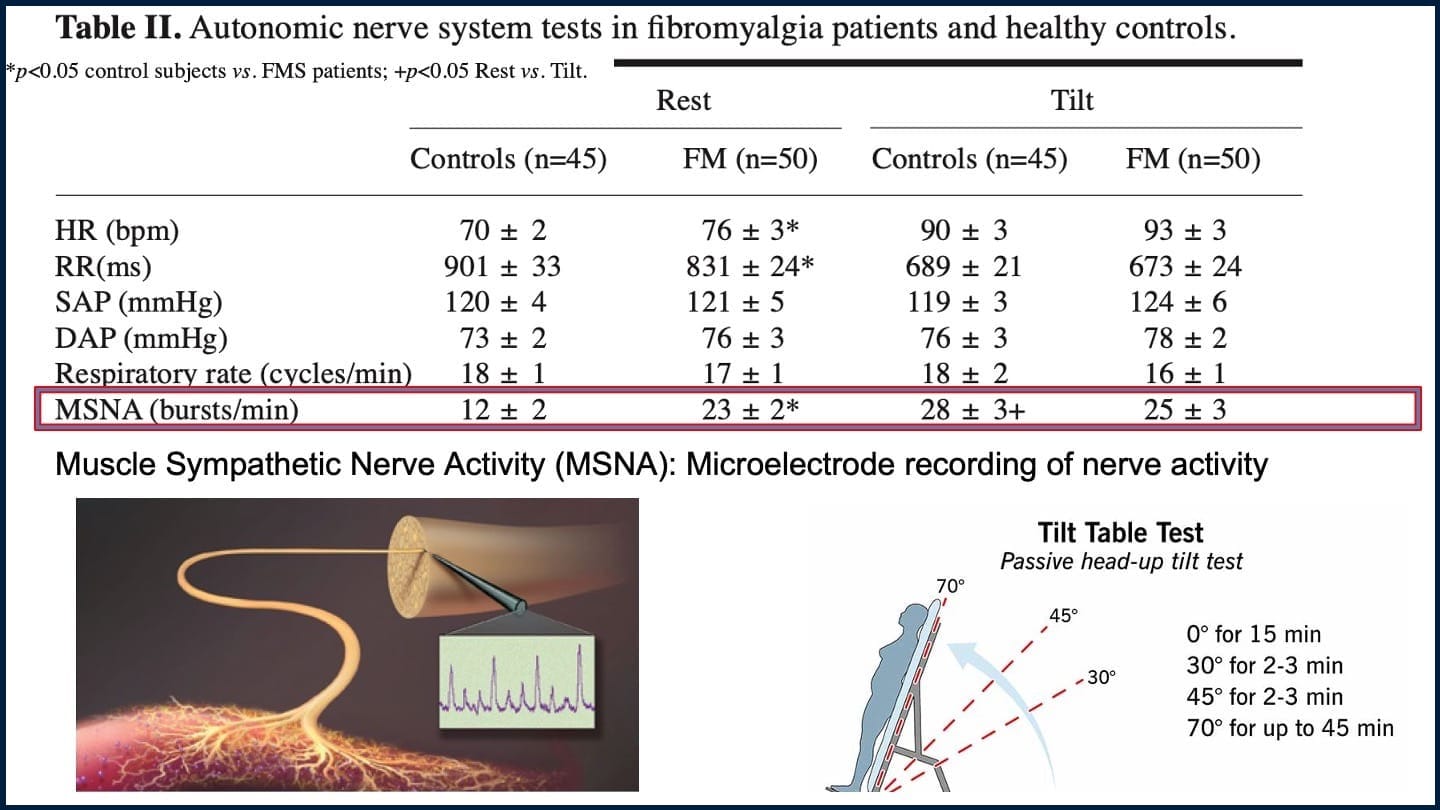
One study compared 16 patients with fibromyalgia and 16 healthy controls who underwent electrocardiography examination, finger blood pressure, respiration, and muscle sympathetic nerve activity (MSNA) recordings at rest and during stepwise tilt test, up to 75 degrees. They reported patients with fibromyalgia had
"an overall enhancement of sympathetic activity while recumbent. Lack of increased sympathetic discharge to vessels might account for the excessive rate of syncope [fainting]... findings seem to be the result of a primary increase of central sympathetic drive" Furlan et al. 2005
In FM the SNS is going almost at max capacity all the time. So when a surge of activation is required during standing, the body is limited by a ceiling effect. If you are already driving 100 miles per hour in a car (close to top speed), even if you slam on the gas pedal you won't be able to increase your speed by much. Medically this is described as sympathetic hyperactivity at rest but with hypoactive responses when it is needed.
Connecting the dots
Fibromyalgia patients show autonomic nervous system dysfunction in the form of abnormal responses to active and passive changes in posture. This contributes to common symptoms of fibromyalgia including fatigue, brain fog, and low blood pressure upon standing.
References with key findings:
 Roland Staud
Dysfunction of the autonomic nervous system is common in fibromyalgia and often becomes quite apparent after positional changes from supine to upright.
 Index by Author
Patients with fibromyalgia have an overall enhancement of cardiovascular sympathetic activity while recumbent. Lack of increased sympathetic discharge to vessels and decreased cardiac vagal activity characterize their autonomic profile during tilt test, and might account for the excessive rate of syncope [fainting]... findings seems to be the result of a primary increase of central sympathetic drive.
 S R Raj
17 women with fibromyalgia and 14 female control subjects underwent a 3 stage head-up tilt table test. 64.7% of the patients with fibromyalgia experienced symptoms during testing compared with 21.3% of controls.
 I Bou-Holaigah
Each subject underwent a three stage upright tilt table test. During stage 1 of upright tilt, 12 of 20 fibromyalgia patients (60%), but no controls had an abnormal drop in blood pressure. Among those with fibromyalgia, all 18 who tolerated upright tilt for more than 10 minutes reported worsening or provocation of their typical widespread fibromyalgia pain during stage 1. In contrast, controls were asymptomatic.
 M Martínez-Lavín
In fibromyalgia there is a deranged sympathetic response to orthostatic stress.
 Manuel Martinez-Lavin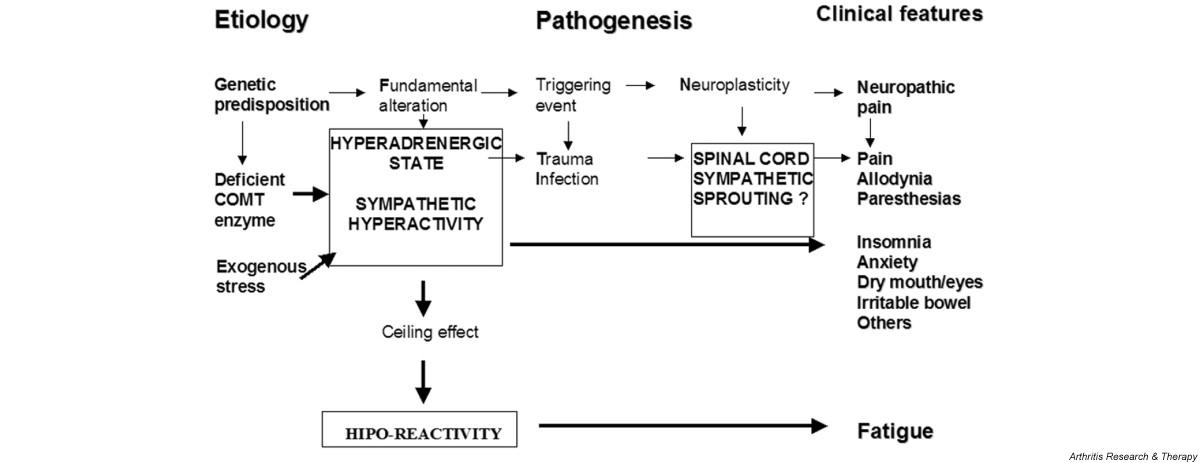
Sympathetic hyperactivity has been consistently described by diverse groups of investigators. Fibromyalgia is proposed to be a sympathetically maintained neuropathic pain syndrome, and genomic data support this contention. Autonomic dysfunction may also explain other fibromyalgia features not related to pain.
 M. Rizzi
At rest FM patients had a higher heart rate and elevated MSNA. During the tilt test they showed no increase in MSNA, a smaller decrease in HFRR, and an excessive rate of syncope (46%) during the tilt test.