
The nervous sweating most of us experience during public speaking is caused by extra sympathetic nerve activity. Heat or stress triggers the sympathetic nervous system (SNS) to send more "sweat" messages to the skin.
The sympathetic relay stations near the spinal cord sends electrical signals all over the body, and some go to the skin to regulate sweating. We can measure SNS activity by first triggering and then measuring the volume of electrical skin signals. This is called the sympathetic skin response (SSR) and it's an indirect, but still useful, way to measure the volume level of the SNS system. And in fibromyalgia the volume is very loud.
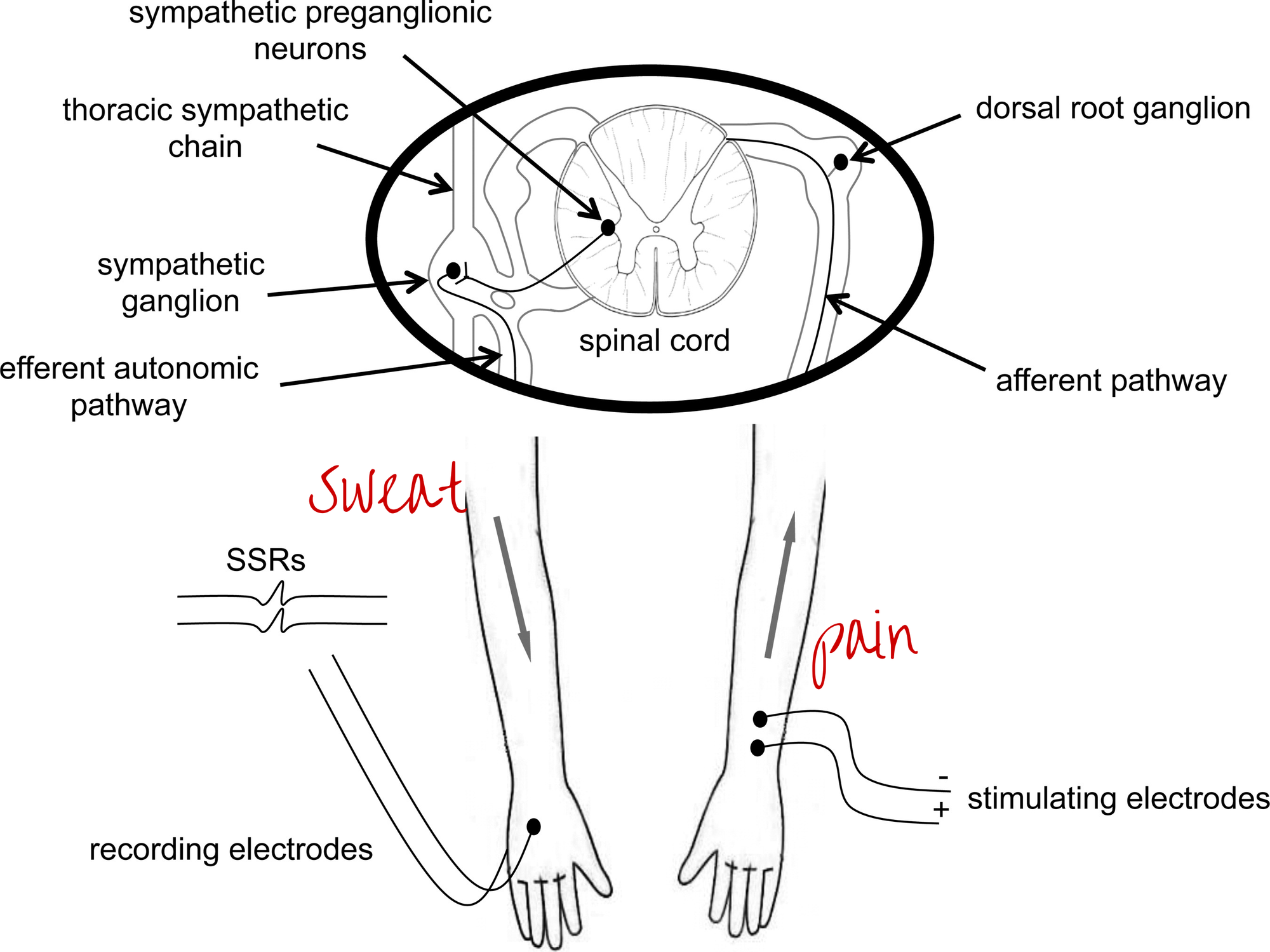
Measuring the Sympathetic Skin Response
Testing starts by sending signals from hand electrode to another. The stimulating electrode sends a small jolt of electricity into a pain-sensing nerve. That electrical signal travels up the pain-sensing nerve to the spinal cord, where it bounces over to an SNS relay station where it is translated from a "pain" signal to a "sweat" signal. The recording electrodes measure the size and speed of the electrical signal sent out from the spinal cord through SNS nerves to the skin. A "pain" input signal that triggers an abnormally large or fast "sweat" output signal reflects a hyper-responsive sympathetic nervous system. It is no surprise that several studies have found a higher sympathetic skin response in fibromyalgia.
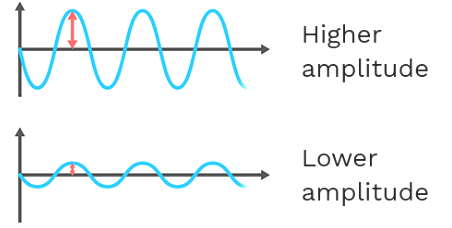
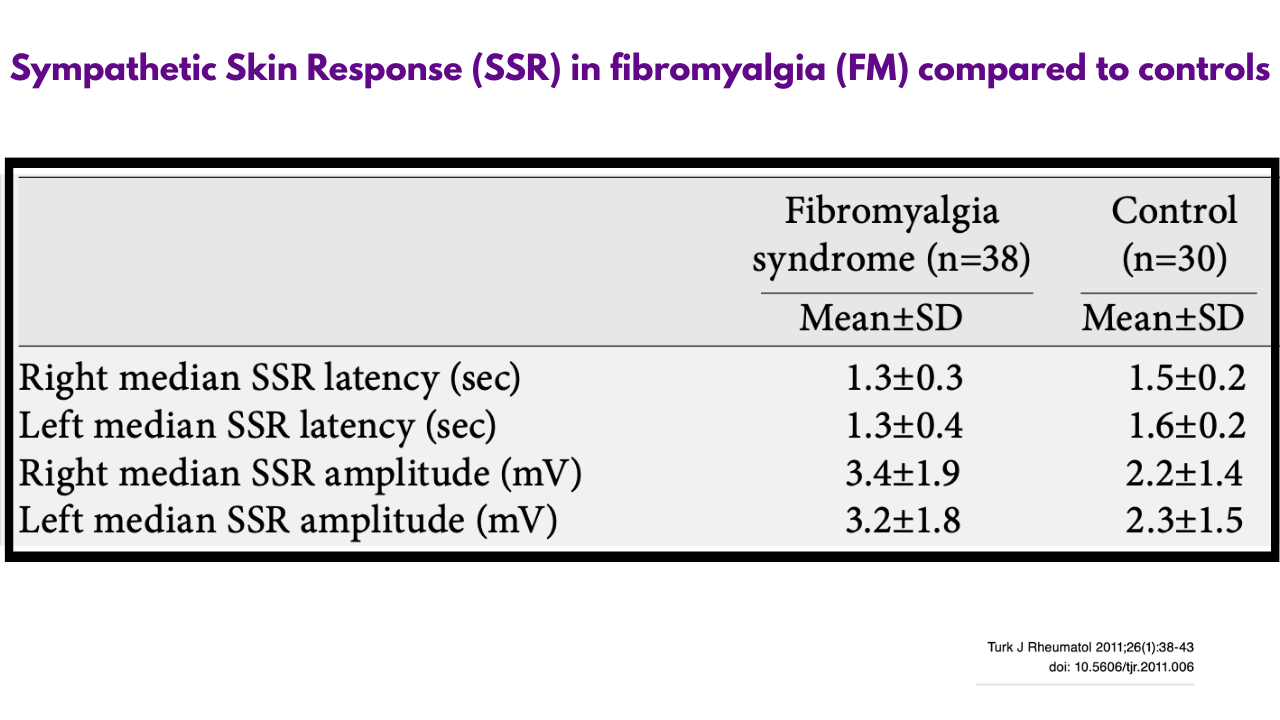
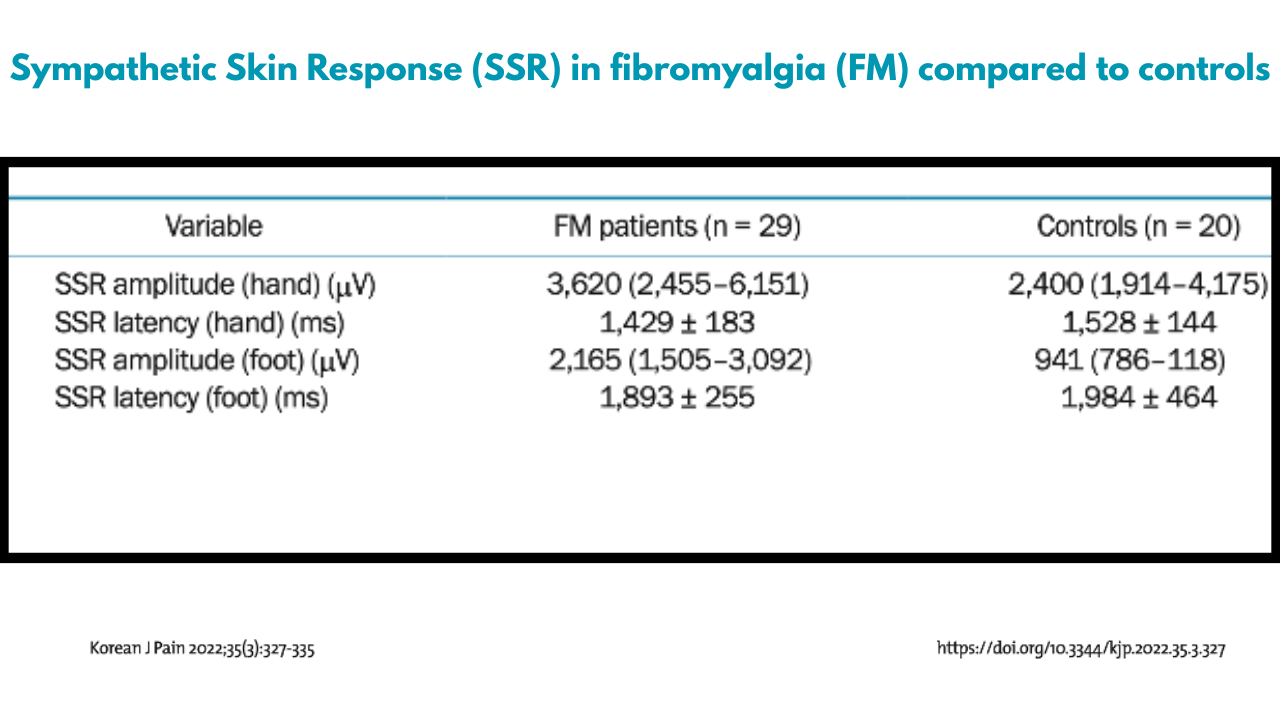
First we have to stimulate the sympathetic nerves to send out electrical signals to the skin, and then measure the size and speed of that signal. Higher amplitude is a bigger wave and lower latency is a faster waves, and each indicate more SNS electrical activity in those nerves. Both bigger waves and faster waves have been found when looking at the sympathetic skin response in fibromyalgia.
This is finicky testing that can be affected by lots of different variables like the temperature of the room, the time of day, and stress levels of the subjects. Some studies have shown conflicting results but most research on SSR in fibromyalgia has found larger and faster electrical signals, indicating excessive SNS activity. One study also found that stronger SSR signals were seen in subjects with more severe fibromyalgia pain and fatigue. Results from these studies are shown below.
Connecting the dots
It is true that correlation does not equal causation, but when you are looking at biomarkers of illness, if symptoms increase as that lab value increases, or vice versa, it adds support to the argument that one is related to the other. And there are other markers of SNS hyperactivity that also correlate with FM symptom severity, like Muscle Sympathetic Nerve Activity. The more different ways we see the connection, the more support it lends to the argument that symptoms stem from SNS hyperactivity.